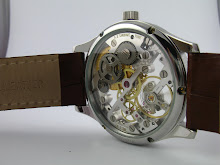
Here is a video I shot of No.1-02.
It is a bit fuzzy, I still need to perfect this. Next time I will try some sort of magnification between the lens & the watch. I wish my camera had macro mode for video :-)
Wednesday, 6 July 2011

Sunday, 19 June 2011
DNA Newspaper
The Pune edition of DNA Newspaper has run a small article on my collection today. It is most flattering to read about oneself in the press :-)

Aditya

Aditya
Thursday, 16 June 2011
No.1-02: Pictures
As promised here are the better pictures.


In the two pictures below you can see how all the hard work on the anglage has paid off.


The blue steel dial marker.

I really like the way the minute hand gracefully arches towards the dial.

On to 03 now!
Kind regards
Aditya


In the two pictures below you can see how all the hard work on the anglage has paid off.


The blue steel dial marker.

I really like the way the minute hand gracefully arches towards the dial.

On to 03 now!
Kind regards
Aditya
Tuesday, 14 June 2011
No1.-02: Completed
Hello after a long break. Many things have happened in the last two months to keep me away from the blog.
Anyway, the watch is complete now. Putting a watch together after all these months of work is always full of suspense. One can never be sure if everything is all right. The proof of the pudding, as they say, is in the eating :-). So here it is, No.1-02. All together and keeping great time! I will take better pictures in the light tent later.


I also made a teak wood box for it.


The name and serial number are laser etched on the box.

A detail shot.

As an additional treat my wife made a small booklet with the story of the making of this watch. This fits into a little compartment in the bottom. It also contains the specifications, care instructions & pages for the service record. No.1-02 is now ready for it's new owner!

I have learnt much during the making of this second watch. One decision I have taken is to give the plates much more pronounced bevelling. I will have to reduce the 'empty spaces' in the plates for this but, in the end, it's all about the overall balance.
Another decision is to dispense with plating altogether. I have suffered much heartburn due to the plating on 02. To date I have not found a source for plating who is capable of delivering 100%. 02 was delayed nearly 2 months because of plating issues. I trust that the protected environment of a watch case will keep the brass from tarnishing. On the other hand, tarnish might add a different dimension to the look of the watch over time. It might even act as a service indicator :-). In any case, bare brass can always be plated at a later date when a good source has been identified & developed.
These are my thoughts as I plan work on No.1-03.
Anyway, the watch is complete now. Putting a watch together after all these months of work is always full of suspense. One can never be sure if everything is all right. The proof of the pudding, as they say, is in the eating :-). So here it is, No.1-02. All together and keeping great time! I will take better pictures in the light tent later.


I also made a teak wood box for it.


The name and serial number are laser etched on the box.

A detail shot.


As an additional treat my wife made a small booklet with the story of the making of this watch. This fits into a little compartment in the bottom. It also contains the specifications, care instructions & pages for the service record. No.1-02 is now ready for it's new owner!

I have learnt much during the making of this second watch. One decision I have taken is to give the plates much more pronounced bevelling. I will have to reduce the 'empty spaces' in the plates for this but, in the end, it's all about the overall balance.
Another decision is to dispense with plating altogether. I have suffered much heartburn due to the plating on 02. To date I have not found a source for plating who is capable of delivering 100%. 02 was delayed nearly 2 months because of plating issues. I trust that the protected environment of a watch case will keep the brass from tarnishing. On the other hand, tarnish might add a different dimension to the look of the watch over time. It might even act as a service indicator :-). In any case, bare brass can always be plated at a later date when a good source has been identified & developed.
These are my thoughts as I plan work on No.1-03.
Sunday, 27 March 2011
THE COLLECTION: Unknown Tissot movement
This is a movement I bought a few years ago. It is a ladies pocket watch movement, something that makes it ideal for a wristwatch project :-)
Even before disassembly, it appeared to be of very good quality. The layout is typically Swiss.

There was a surprise under the dial, the Tissot name. However, I have been advised that this is not the Tissot. I would be very obliged if anybody could throw some light on this Tissot.

On barrel bridge we can see this 'HB' logo. Also, the regulator is marked 'fast-slow' as against 'avance-retard' which was more common on the continent.

It is evidently a good quality movement. It has a Breguet over-coil hairspring. The balance, lever & escape wheel pivots are capped on both sides.

An interesting feature is the side, English type of lever. This indicates an early date. Perhaps before the entire Swiss industry adopted the anchor escapement.
Every part reeks of quality. even parts that would only be seen by a watchmaker have been carefully finished.


This movement is fortunate to still have the Geneva stop-work intact. This is a feature little understood by watchmakers & was generally discarded during servicing.

The only real problem this movement had was with the balance. As you can see in the picture below, the roller table was miss-aligned and, indeed, loose.
 ... an easy fix on the staking set.

I hope you enjoyed reading about this beautiful movement. One day I will make a nice dress watch using it :-)
Aditya

Even before disassembly, it appeared to be of very good quality. The layout is typically Swiss.

There was a surprise under the dial, the Tissot name. However, I have been advised that this is not the Tissot. I would be very obliged if anybody could throw some light on this Tissot.

On barrel bridge we can see this 'HB' logo. Also, the regulator is marked 'fast-slow' as against 'avance-retard' which was more common on the continent.

It is evidently a good quality movement. It has a Breguet over-coil hairspring. The balance, lever & escape wheel pivots are capped on both sides.


An interesting feature is the side, English type of lever. This indicates an early date. Perhaps before the entire Swiss industry adopted the anchor escapement.

Every part reeks of quality. even parts that would only be seen by a watchmaker have been carefully finished.


This movement is fortunate to still have the Geneva stop-work intact. This is a feature little understood by watchmakers & was generally discarded during servicing.

The only real problem this movement had was with the balance. As you can see in the picture below, the roller table was miss-aligned and, indeed, loose.
 ... an easy fix on the staking set.
I hope you enjoyed reading about this beautiful movement. One day I will make a nice dress watch using it :-)
Aditya
Thursday, 17 March 2011
Finishing small parts
I have spent the last few weeks finishing various small parts that go into the movement. I want 02 to be absolutely perfect.
Below you can see some of the parts from the keyless work. All the parts have had their flanks & top surfaces straight grained and edges bevelled. The screw heads have been polished.

 ------------------------------
Part of the cannon pinion & centre pinion will be seen through the minute hand hub. These have been polished too.

 ------------------------------
The movement screws have had their heads & ends polished. The ends will be visible from the dial side. The flanks of the screw heads have been straight grained.
 ------------------------------
Here are the dial markers. The heads have been domed & mirror polished. The flanks of the heads are straight grained.

The ends have been polished as well.
 ------------------------------
The winding wheel has been skeletonised, bevelled & straight grained. The click & transmission wheel have straight grain finish on the top surfaces. I think the wheels will look interesting when the watch is wound since a straight grain finish changes with the light.
 ------------------------------
The end of the barrel arbour.
 ------------------------------
The balance spring stud holder (I have left the regulator alone since finishing the top surface will disturb the curb pins).
 ------------------------------
The crown, castle & intermediate wheels from the keyless work.
 ------------------------------
and finally, the barrel & motion works.

I hope all this effort pays off :-)
Aditya
Below you can see some of the parts from the keyless work. All the parts have had their flanks & top surfaces straight grained and edges bevelled. The screw heads have been polished.


 ------------------------------
Part of the cannon pinion & centre pinion will be seen through the minute hand hub. These have been polished too.

 ------------------------------
The movement screws have had their heads & ends polished. The ends will be visible from the dial side. The flanks of the screw heads have been straight grained.
 ------------------------------
Here are the dial markers. The heads have been domed & mirror polished. The flanks of the heads are straight grained.

The ends have been polished as well.
 ------------------------------
The winding wheel has been skeletonised, bevelled & straight grained. The click & transmission wheel have straight grain finish on the top surfaces. I think the wheels will look interesting when the watch is wound since a straight grain finish changes with the light.
 ------------------------------
The end of the barrel arbour.
 ------------------------------
The balance spring stud holder (I have left the regulator alone since finishing the top surface will disturb the curb pins).
 ------------------------------
The crown, castle & intermediate wheels from the keyless work.
 ------------------------------
and finally, the barrel & motion works.

I hope all this effort pays off :-)
Aditya
Sunday, 27 February 2011
The Hands Part4- Finishing
Now that the profile of the minute hand is frozen, the two hands can be hardened. This is done by heating to red & quenching in water. The hands must be bound in wire since the heat treatment can distort them.  After hardening the hands are tempered to spring. This ensures that they will retain their shape throughout the finishing process & indeed when the watch is serviced.
After tempering the absolute final shaping is done with the escapement files.


 Then the flanks & top surfaces are finished with paper and the edges are bevelled.

This is the result........

A close-up...

Now all that remains as far as the hands are concerned is bluing.
Aditya
 After hardening the hands are tempered to spring. This ensures that they will retain their shape throughout the finishing process & indeed when the watch is serviced.
After tempering the absolute final shaping is done with the escapement files.


 Then the flanks & top surfaces are finished with paper and the edges are bevelled.
This is the result........

A close-up...

Now all that remains as far as the hands are concerned is bluing.
Aditya
Subscribe to:
Posts (Atom)