skip to main |
skip to sidebar
I have been working on a couple of No.3 commissioned pieces. I took the opportunity to fine tune the design. Compare the picture below with the first picture in this post-
http://awatchmakersdiary.blogspot.in/2012/08/no3-00-finished.html
It is marginally more open and the lines are cleaner and more elegant ..... or at least I think so :-)
Here is another style of hands I made for the No.3 watch.
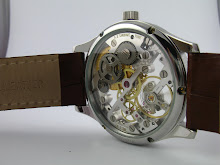
Over the years many people have written to me about my skeleton watches. Some have inquired if I have a uniquely Indian watch. Some have mentioned that even 41mm is quite large for their wrists. Many have requested me to make something a little more accessible.Well, No.3 is an answer to all these requests! It is based on the venerable HMT hand wound 020 movement (which is basically a license built Citizen 0201). One feature of this movement is that it has direct centre seconds. So you get a unique layout of the train and none of the infamous second hand slop. Here are some pictures of the skeletonised movement (minute wheel is yet to be done).
 This movement will have blued steel hands and will be housed in a 36mm stainless steel case with sapphire crystals front and back. Stay tuned :-)
Hello after a long break,I have been doing some interesting work and hope to make up a bit for the lack of posts :-)I have been looking into clock repair for the past few months. The way a clock works is basically similar to the way a watch works. However, the scale is different and so the problems & the way one deals with them are different.I had bought this Smiths mantle clock with Westminster chimes for a pittance many years ago. (sellers picture) The glass was missing and it would not run. A perfect practice clock, I thought!Here you can see the rear of the movement out of the case.
 and the front with all the flirts, racks etc for the chiming & striking mechanism
 And here are the three trains with the back plate removed (chiming is closest, then the time train and the strike train is furthest). It is not obvious in the picture but the chiming barrel is much larger than the other two.
What was surprising for a person who has only worked on watches was the quantity of dirt inside.  Almost every pivot hole had a thick greasy paste pouring out. On close examination I got the impression that this clock was never serviced, it was worked till it stopped.
And it is this dirt that causes a clock to wear out and, eventually, stop. In the picture below you can clearly see how the hole has been worn to an oval. The arrow marks where the hole should be. An oval hole brings wheels closer than they should be. This results in poor power transmission and finally in stoppage.The solution is to fit a brass bush. To do this, the hole in the plate needs to be broached open. This has to be done carefully so that the new hole is concentric to the original hole and not the worn out oval hole. In the case of my clock the unworn portions of the hole and the oil sinks acted as a guide. Broaching is always done from the inside, so the hole tapers towards the outside. Also, a bush with a hole smaller than the pivot it is to recieve and a taper that just about enters the broached hole in the plate is turned.
The bush is hammered into the hole....

...and riveted from the other side. Now the hole is opened for the pivot and a new oil sink is formed. This clock needed four bushes. I fitted a new plastic crystal (the correct size glass was not available).I am happy to say that it is working, chiming & striking beautifully now.
 Thankfully my wife & son too are quite pleased with all the chiming & striking :-)