Sunday, 28 June 2015

Making a balance staff

Making a balance staff is one of the most demanding jobs in watch repair. This is because the balance pivots can be as small as 0.1 mm in diameter. Also, there are numerous clearances and tolerances to be taken care off. Over the years I have made and collected the tools required for this delicate operation. Last week I decided to take the plunge.

In the picture below you can see the balance with the balance spring and roller table removed. The old staff is on the balance and you can also see a balance staff blank. One can start with a blued steel rod but a blank saves a bit of time.


The old staff is removed. I did this on the turns because it is slower and offers more control. Care should be taken that the balance is not touched while cutting the rivet, nor should it be distorted during removal of the old staff.


Below you can see the blank mounted on the special runners I made for my turns. First, the seat for the balance is turned and then the arbor for the balance spring. The balance should be a perfect fit. Too tight and it will get distorted, too loose and it will be out of round. 


Here is the partially turned staff ready to be mounted on the balance. Mounting the staff at this stage eliminates the need of a dog.

And here is the staff riveted to the balance.

 Next, the arbor for the roller table is turned. Finally, the two pivots are turned. One can safely reduce these only to about 0.3-0.2 mm on the special runners. Beyond this the pivots are reduced on the Jacot tool. This is a special turns made specifically for reducing and rounding off fine pivots.


Below you can see the finished staff with the correct diameter and lengths of the two pivots. There is scope for improvement, particularly in the shape of the pivots and polishing. All the same, it feels nice to be able to make something so tiny and delicate.

The proof of the pudding is in the eating. So, here is the staff during a test assembly-

Kind regards

Aditya

Monday, 25 May 2015

No.6 Skeleton Wristwatch

It gives me great pleasure to present the No.6 skeleton wristwatch. This is a new direction for A D Sambhare watches, Big and bold!

No.6 has a fully skeletonised Swiss ETA-6498 movement with hours and minutes. 

The Swiss made 316L stainless steel case is 44mm in diameter (excluding the crown), 11mm thick and has sapphire crystals front and back.


'Big and Bold'  also describes this rendition of the blued steel 'Sambhare' hands.


ADS logo at the 12 O'clock position.

The escapement.
Kind regards

Aditya

Monday, 30 March 2015

No.4 on a bracelet

I put No.4-00 on a 20mm bracelet I had and I am very pleased with the result. Over the past year this bracelet has adorned 4 or 5 of my watches but I think it belongs here :-)


Wednesday, 21 January 2015

Uprighting tool

I bought this tool off ebay a while ago. An un-jeweled hole can sometimes be worn to an oval shape by it's pivot. This tool allows one to centre the worn hole of a wheel with respect to the other, unworn, hole.


Unfortunately, it only came with the centering runner. So, I made a runner that can carry reamers of various diameters. Below, you can see what I made, a runner, a grub screw and a reamer. The reamer is a bit rough but I shall make another one. This is because now I know what dimensions are required.


And here is how the the whole thing looks assembled.


I tried this on a junk movement. Below you can see how the unworn hole is centered and the movement is secured.


After this the bridge with the worn hole is fixed to the plate and the reamer is passed through it.


The reamed hole will need a bush and the hole in the bush will need to be opened up to the correct diameter. Altogether, I am pleased that this works!

Thursday, 9 October 2014

A special order commemorative watch

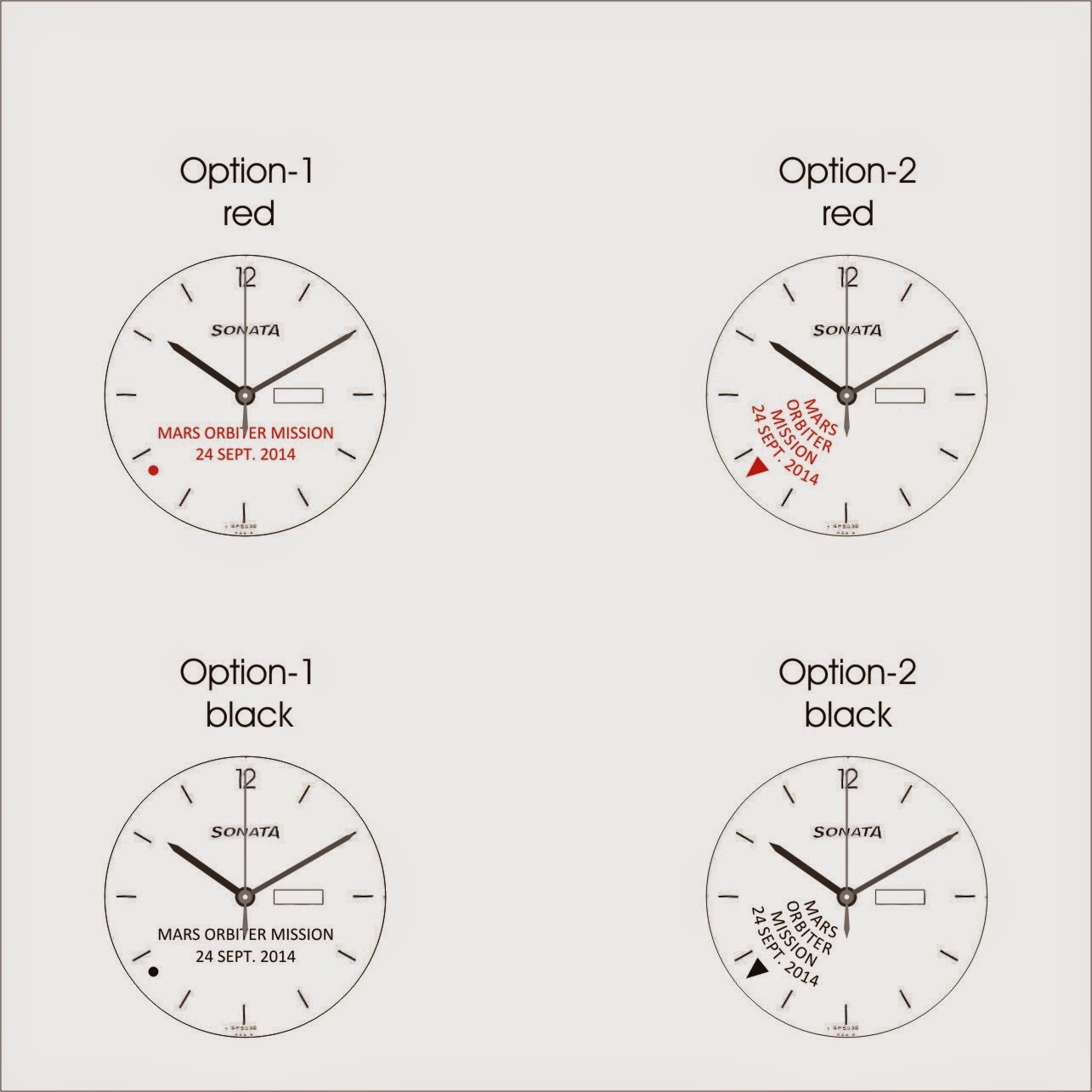
A prominent journalist, Mr Srinivas Laxman, who is passionate about and has covered space exploration for a long time wanted a watch to commemorate the recent Mars orbiter mission. Here is what I did for him.
 The little red dot marks the time when the orbiter was inserted into Mars' orbit, 07.42 AM.


And here are the other options-

In option-2 I aligned everything to the the 07.42 position. This was to give that time it's due importance.

Thank you for the opportunity Mr. Laxman!


Sunday, 14 September 2014

No.5, Videos

Some videos of No.5-00


Sunday, 17 August 2014

No.5 Skeleton wristwatch

It gives me great pleasure to announce a new model, the No.5 skeleton wristwatch. 


This is my most adventurous skeleton design yet. The movement floats in the 41mm case supported only by an elegant yet robust bridge at the 3 o'clock position. The extreme skeletonising and the additional breathing space throw open almost the entire movement. 

As usual, I allow the movement pride of place. The aesthetics are governed by the machine and the flowing lines frame key components. The movement is in frosted brass complemented by the heat blued steel 'Sambhare' hands.

This design requires greater precision. With such a small bearing surface even a small error can result in misaligned dial & hands or faulty winding/setting. The dimensions need to be perfect but the surfaces need to perfectly true as well.

I am particularly pleased with the tweaked proportions of the 'Sambhare' hands.


Sunday, 16 February 2014

Making a hand

At some point in it's long life this watch lost all of  it's hands. Some research indicated that I had a minute hand in the correct style in my parts box. The hour hand had to be made.


I started with sheet brass. The hole for the cannon/hour wheel is always the starting point of any hand. Below, you can see the basic design has been scribed with the hole as reference.

Rough milling- 


 Basic shaping-


 All shaping done, polishing not done yet-

Brass is much softer than tempered steel. This makes filing and sanding much easier. But therein lies the problem. It is also much easier to remove too much material and bend the hand. I have a renewed respect for those who make hands out of gold!


Thursday, 6 February 2014

Where would one find an A D Sambhare watch in the wild?

Over the last few years I have received inquiries from all over the world, in fact right from Hawaii to Arunachal pradesh! As of today this is where my watches have gone. 


Needless to say, My aim is world domination!!


Wednesday, 29 January 2014

163 years old!

This is a seven jewel English fusee from 1851. I just finished restoring this watch to working condition. A lot was wrong with it. It took a lot of work to sort everything out but I think it is ready for another 163 years of service. And this is one of the reasons why I love mechanical timepieces, they can be fixed!

So here it is. The dial is a little tired but I think it wears it's age with pride. The case is sterling silver and hallmarked for Birmingham, 1851.

And here is the lovely movement. 

The hole for the fusee arbour in the back plate presented a bit of a problem. Most of these watches had a bush at this location even when new. This is corroborated by the fact that often the bush too is gilded. Well, in this watch the hole for the arbour was not concentric with the bush. Since it was worn I had to replace it. So I plugged the hole, took the fusee-centre wheel and fusee-third wheel centre distances from the dial plate, and marked them on the plug (red arrow, below). 

The barrel hook for the fusee chain had to be made 

The balance cock had indentations on the underside to increase the end-shake. Closer examination revealed that the entire backplate was bent, it would not sit flush on all the pillars. So, the resultant reduction in end-shake was compensated for by punching up material in this manner. A good example of how one problem is solved but another is created. Needless to say, I straightened the plate and cleaned up the underside of the balance cock. 

This watch has an English lever escapement. In this watch the exit pallet was locking too deeply, with the result that the tooth of the escape wheel would not leave the pallet. The cure is to adjust the locking. This is done by adjusting the lever. The lever is two parts held together with a brass rivet (red arrow, below). The locking can be adjusted by rotating the parts relative to each other (green arrow, below). The trouble is that one cannot see the escapement in action. The only way is to make an adjustment and test in the movement using ones judgement. 

The dial carrier plate had a missing foot. This was causing the motion works to foul and stop the watch. A new foot was made (red arrow, below) and installed.

One of the pins that help keep the back cover in place was missing. Due to this, the back cover would occasionally foul with the lever and stop the watch. A new foot was made and installed (red arrow, below) 

I find this sort of work very fulfilling!

Saturday, 7 December 2013

No.4-00, more pictures

These pictures were taken by the future owner of No.4-01. I think they are refreshingly different from the clinical pictures I take in the light tent. Of course, the fact that he has a great camera and is an ace photographer also helps!

Here it is on his wrist-

And on mine-


And here I am wearing the watch. I am just happy that the watch looks better than it's maker :-)